

Views: 0 Author: Site Editor Publish Time: 2026-01-27 Origin: Site
In the hospitality industry, a distinct tension exists between controlling operational expenses (OpEx) and delivering the flawless tactile experience guests demand. Hoteliers often find themselves balancing a tight budget against the need for pristine sheets and towels, yet the cost of getting it wrong is high. Linen degradation is frequently invisible to staff who handle these items daily; the gradual decline in whiteness or softness can go unnoticed by the internal team until it is too late. However, to a guest entering a room for the first time, a frayed hem or a scratchy towel is immediately obvious.
This gap in perception directly impacts Guest Satisfaction Scores (GSS) and can devastate an online reputation. To solve this, management must shift the conversation away from arbitrary calendar dates, such as replacing stock "every year." Instead, successful properties utilize quantifiable metrics. By tracking wash cycles and fiber integrity, you can determine exactly when your hotel linen has reached the end of its viable life, ensuring maximum ROI without compromising quality.
Wash Cycles over Months: Commercial linen lifespan should be measured in laundry cycles (typically 100–150 for sheets), not just calendar time.
The Inventory Leverage: Increasing Par levels from 3 to 4 can extend individual asset lifespan by 20–40% by allowing fibers to "rest" and rehydrate.
Functional vs. Cosmetic Failure: Replacement criteria must include functional failure (e.g., towels losing absorbency) alongside visual defects (fraying or graying).
CapEx Smoothing: Implementing a quarterly "modular rotation" strategy prevents massive cash flow spikes and maintains consistent room quality.
The traditional method of budgeting for linen replacement based on time—such as buying new stock every January—is fundamentally flawed. This approach ignores occupancy fluctuations. A hotel running at 90% occupancy burns through inventory nearly twice as fast as one running at 50%, yet a calendar-based budget treats them the same. To maximize the value of your assets, you must measure longevity in wash cycles.
A "wash cycle" includes the mechanical action of the washing tunnel, the chemical exposure to alkali and bleach, high-heat drying, and the physical stress of ironing. Each cycle removes a microscopic layer of fiber and finish. Eventually, the fabric loses its structural integrity. Below is a benchmark guide for expected lifespan across different asset classes under normal commercial laundry conditions.
| Asset Class | Material Composition | Expected Wash Cycles | Est. Lifespan (High Occupancy) |
|---|---|---|---|
| Standard Sheets | Cotton/Poly Blend (T180-T250) | 100–150 cycles | 12–18 months |
| Luxury Sheets | 100% Cotton (T300+) | 70–100 cycles | 10–14 months |
| Towels | 100% Cotton Terry | 70–100 cycles | 9–12 months |
| Pillowcases | Cotton or Blend | 70 cycles | 8–10 months |
| Napkins | Spun Polyester | 80–100 cycles | 12–20 months |
| Napkins | 100% Cotton | 40–60 cycles | 6–9 months |
It is important to note that pillowcases have a shorter lifespan than flat sheets. They endure the highest amount of friction from direct contact with the guest's head and hair. They are also exposed to more cosmetic oils, creams, and hair products, necessitating more aggressive washing formulas that degrade fibers faster.
A common misconception in procurement is that higher thread count equals longer life. In a retail setting, this might be true, but in an industrial setting, it is often the reverse. To achieve thread counts above T300 or T400, manufacturers use finer, thinner yarns twisted together. While these feel incredibly smooth, they are physically weaker than the robust, thicker yarns used in T200 or T250 percale weaves.
Under the high pressure of an industrial ironer (mangle), fine yarns can snap more easily. For most commercial properties, the "sweet spot" for durability and comfort lies between T200 and T250. This range provides a crisp feel without the fragility associated with ultra-high thread counts, ensuring your inventory survives the rigors of daily processing.
Housekeeping managers often rely on obvious defects—large tears or distinct stains—to pull linen from circulation. However, waiting for a hole to appear means the guest has already been sleeping on degraded fabric for weeks. To maintain high standards, your team needs a professional inspection framework that detects failure before it becomes a complaint.
The structural death of a sheet happens long before it rips. As cotton fibers wear down, the weave begins to separate. You can detect this by holding a pillowcase or sheet up against a bright window or a specialized light box. If you see a grid-like transparency where light shines through clearly, known as "thinning," the fabric has lost its tensile strength. It may not have a hole today, but it will likely tear during the next bed-making shift. Retiring these items proactively prevents the embarrassment of a sheet ripping while a guest is in bed.
Visual inspections are necessary, but they are not sufficient. Guests interact with luxury hotel bed linen primarily through touch. Brand new linen has a smooth hand feel, often enhanced by sizing agents during manufacturing. Over dozens of wash cycles, the fiber surface becomes abraded. If a sheet feels crisp in a brittle way, or sandpaper-like rather than cool and smooth, the finish has been stripped away. This is "tactile failure." The item serves its function as a cover, but it fails its function as a luxury experience.
For terry products like towels and bath mats, the primary function is drying. A towel can look perfectly white and fluffy but fail completely at its job. This often happens due to a buildup of silicone-based fabric softeners or the crushing of the pile loops over time. If water beads on the surface of a towel rather than absorbing immediately, the item has functionally failed. No amount of whiteness can compensate for a towel that simply pushes water around the guest's skin.
Stains fall into two categories: treatable and permanent. Your laundry team must distinguish between the two to avoid wasting money washing dead stock. "Graying" is typically caused by the redeposition of suspended soils or hard water minerals onto the fabric. "Yellowing" is often a sign of chemical oxidation from high heat or residual alkaline. Once a fabric has chemically grayed or yellowed overall, it is rarely recoverable. Continuing to wash these items wastes water, energy, and labor. They should be culled immediately.
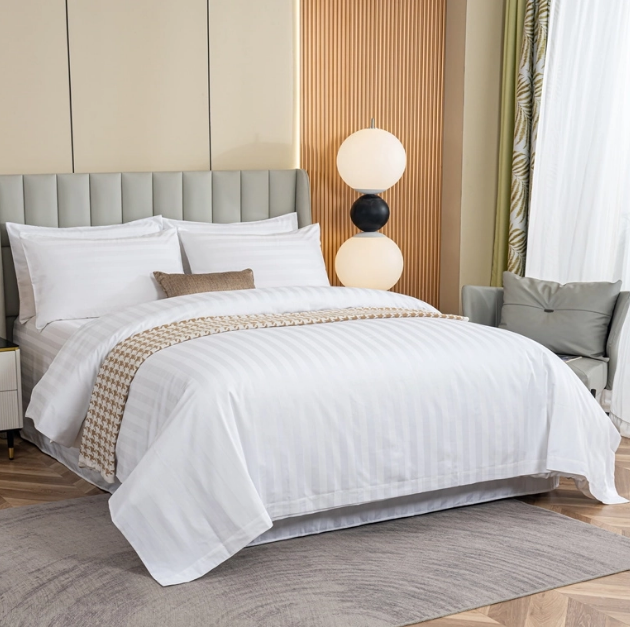
The total cost of ownership (TCO) for your linen is heavily influenced by your Par level. Par refers to the number of sets of linen available per room. The standard operational minimum is 3-Par:
One set in the room (on the bed).
One set in the laundry (being processed).
One set on the shelf (ready for the next shift).
While 3-Par is the operational baseline, it leaves zero margin for error. If the laundry equipment breaks down or occupancy spikes, you run out of linen. More importantly, 3-Par destroys your inventory faster than 4-Par.
Cotton is a natural fiber that requires hydration to maintain its strength. When linen comes out of a high-heat industrial dryer or ironer, it is "bone dry" (roughly 0-1% moisture content). In this state, cotton fibers are brittle and prone to snapping. If that sheet is immediately taken from the laundry cart and put back onto a bed, it hasn't had time to recover.
Ideally, linen should rest on a shelf for 24 hours in a climate-controlled storage area. This allows the fibers to reabsorb ambient humidity, returning to a natural moisture content of roughly 7–8%. This rehydration restores flexibility to the cotton. Moving from 3-Par to 4-Par allows for this rest period. Studies suggest that this simple 24-hour rest can extend the life of the asset by 20–30%.
The math supports the investment. The upfront cost of purchasing a 4th Par is significantly lower than the accelerated replacement costs caused by over-washing a small inventory pool. You buy more upfront, but you buy less frequently over the long term. Furthermore, this buffer protects you against supply chain delays. Establishing a consistent restocking cadence with your hotel linen distributor is far safer than panic-buying. When you operate too lean, a single busy weekend can force you to pay expedited shipping for emergency stock, eroding your profit margins.
Many hotels fall into the "Financial Trap" of waiting for total inventory collapse. They purchase a full stock of linen, use it until it is uniformly gray and tattered, and then face a massive, unbudgeted capital expenditure (CapEx) to replace it all at once. This approach creates wild spikes in cash flow and ensures that toward the end of the cycle, every guest experiences poor quality.
A superior strategy is "Modular Rotation." In this model, you aim to replace roughly 25% of your inventory every quarter. By constantly injecting new stock into circulation, you stabilize your cash flow, turning a massive CapEx spike into a predictable monthly operational expense.
This method also averages out the quality in the rooms. Rather than a period where 100% of the linen is old, your mix always contains fresh, crisp items. The new linen elevates the overall perception of the bed, masking the slight wear of mid-lifecycle items.
When linen is retired from the guest room, it should not immediately go to the dumpster. A defined retirement flow maximizes utility:
Downgrade: Sheets with small stains or tears can be cut down and hemmed into crib sheets or used as maintenance rags for cleaning staff.
Donate: Items that are structurally sound but cosmetically imperfect (e.g., slight off-white color) are often welcomed by animal shelters or homeless shelters.
Recycle: For items that are unusable, partner with textile recyclers who can shred the material for insulation or industrial wipes, helping you meet sustainability goals.
Who you buy from is just as important as what you buy. The market is flooded with generic textiles, but professional hotel linen suppliers offer specific features designed for the rigors of hospitality.
One of the biggest frustrations for housekeeping is mismatched inventory. If you buy sheets in January and a top-up order in June, they must match in whiteness and texture. If the supplier sources from different mills for every batch, you will end up with a bed that looks like a patchwork quilt of different white shades. You need a partner who guarantees consistency over multiple years.
When interviewing suppliers, ask about the construction details that extend lifespan:
Lock-stitched Hems: The hem is often the first part of a sheet to fail. Lock-stitching prevents the entire hem from unraveling if a single thread breaks.
Mercerized Cotton: This chemical treatment swells the cotton fiber, making it rounder. This increases luster, improves dye affinity, and strengthens the fabric against mildew.
Selvedge Edges: Woven edges on the sides of flat sheets prevent tearing and maintain shape as the sheet passes through the ironer.
While going direct-to-mill might seem cheaper, using a distributor often provides better logistics support. A distributor can warehouse your "safety stock" (that 4th Par), releasing it to you only when you have the storage space. This reduces your onsite storage burden while ensuring stock is available immediately when needed.
Linen is an operational asset, not just a disposable commodity. Managing it effectively requires a shift from intuition to data. By tracking wash cycles rather than months, maintaining disciplined Par levels to allow fiber rest, and implementing a strategic quarterly rotation, you can significantly reduce your cost per occupied room.
Ultimately, the guest experience is the final judge. If you find yourself debating whether a piece of linen is "good enough" for a guest, the answer is almost certainly no—it likely needed replacing a month ago. Conduct a "Light Box" audit of your current stock this week, identify your actual wash cycle counts, and contact a specialist to discuss a consistent replenishment plan. Your bottom line—and your reviews—will thank you.
A: Pillows have two lifespans: hygiene and structural. Structurally, a pillow loses support after 12–18 months. However, for hygiene, many hotels replace synthetic pillows every 6–12 months unless high-quality protectors are used. Sheets, by comparison, are replaced based on wash cycles (12–18 months). Always use protectors to extend the pillow's hygiene life, but replace them immediately if they become lumpy or permanently stained.
A: The ideal level for luxury operations is 4-Par. This includes one set in the room, one in the laundry, one in the closet, and one in "rest/recovery" storage. This extra set allows cotton fibers 24 hours to rehydrate after drying, which prevents brittleness and extends the linen's life by up to 30%. It also provides a safety buffer against laundry equipment failure or delivery delays.
A: Lowering temperatures can reduce fiber stress, but there is a strict trade-off with sanitation. Commercial standards require specific temperatures (often 160°F/71°C) to kill pathogens and activate bleaching agents. Dropping below this risks guest safety and results in dingy linen that requires re-washing (which damages fibers more). It is better to optimize chemical formulas than to lower temperatures below sanitary standards.
A: It depends on your priority. For true luxury properties, 100% cotton is the standard for its breathability and cool feel, though it has a shorter lifespan. For mid-scale and high-volume hotels, a cotton/poly blend (e.g., 60/40 or 50/50) offers a significantly better ROI. Blends last 30–50% longer, dry faster (saving energy), and wrinkle less, while modern processing makes them feel very similar to cotton.


