

Views: 0 Author: Site Editor Publish Time: 2026-01-29 Origin: Site
Sourcing commercial linens is a high-stakes balancing act that directly impacts your bottom line. Guests judge their entire stay by the tactile, "cloud-like" experience of the sheets, while housekeeping directors prioritize tensile strength, stain release capabilities, and wash cycle longevity. It is not enough to simply buy what looks good; you must buy what survives the rigors of industrial laundry. For hotel owners and procurement managers, this decision goes far beyond aesthetics. It requires a rigorous evaluation of supply chain reliability, the consistency of whites over multi-year contracts, and the true Total Cost of Ownership (TCO) per room night. A cheap sheet that tears after thirty washes ultimately costs significantly more than a premium sheet that lasts a hundred.
This guide cuts through the marketing fluff to analyze top global suppliers and the technical specifications that define true hotel quality bedding. We will explore the metrics that matter, from weave types to par levels, ensuring your investment yields returns in both guest satisfaction and operational efficiency.
The Thread Count Myth: For commercial use, the "sweet spot" is 200–400 thread count. Anything higher (800+) often sacrifices breathability and durability for marketing appeal.
Par Level Standards: To extend linen life and handle turnover peaks, industry best practices dictate maintaining 3 to 5 Pars (inventory sets) per bed.
Material ROI: While 100% Egyptian cotton offers premium luxury, a 60/40 or 70/30 Cotton-Poly blend often provides the best balance of comfort and operational longevity for mid-scale properties.
Hidden Costs: Evaluate suppliers not just on unit price, but on shipping flexibility, restocking consistency, and wash-life guarantees.
Before selecting a supplier, buyers must distinguish between retail marketing terms and commercial performance metrics. The hotel collection bedding sets sold in department stores differ significantly from the commercial-grade linens used in hospitality. Retail products are designed for shelf appeal and occasional home washing, whereas hospitality linens are engineered to withstand high temperatures, alkaline detergents, and heavy mechanical extraction.
Retail sheets prioritize immediate softness to secure a sale on the shop floor. Commercial sheets, however, prioritize tensile strength—the fabric's resistance to tearing under the high speeds of industrial extractors. A sheet that feels incredibly soft but lacks structural integrity will fail quickly in a commercial laundry setting.
Procurement managers should look for suppliers who publish "wash cycle" expectancies. A standard commercial rating might promise 50 to 100 industrial washes before the fibers begin to degrade. If a supplier cannot provide this data, it is a red flag that their product may be retail stock repackaged for sales.
Marketing has trained consumers to believe that higher thread counts equal better quality, but in the hospitality sector, this is often a misconception. High thread counts (600–1000) are frequently achieved by twisting thinner, weaker plies together to artificially inflate the count. These multi-ply yarns often lack breathability and take longer to dry, increasing energy costs.
Decision Rule: Stick to Single-Ply constructions. A crisp 250–300 thread count is ideal for standard rooms, providing durability and ease of laundering. For luxury hotel bedding in suites, you may go up to 400 thread count to ensure a smoother hand-feel, but going beyond that often yields diminishing returns on durability.
A major procurement risk is "batch variation." If you buy replacement sheets in 12 months, they must match the current inventory perfectly. Slight variations in shades of white can make a bed look dirty or mismatched. You should verify if the supplier uses optical brighteners or specific bleaching processes that are compatible with your laundry chemistry to ensure whites stay brilliant over time.
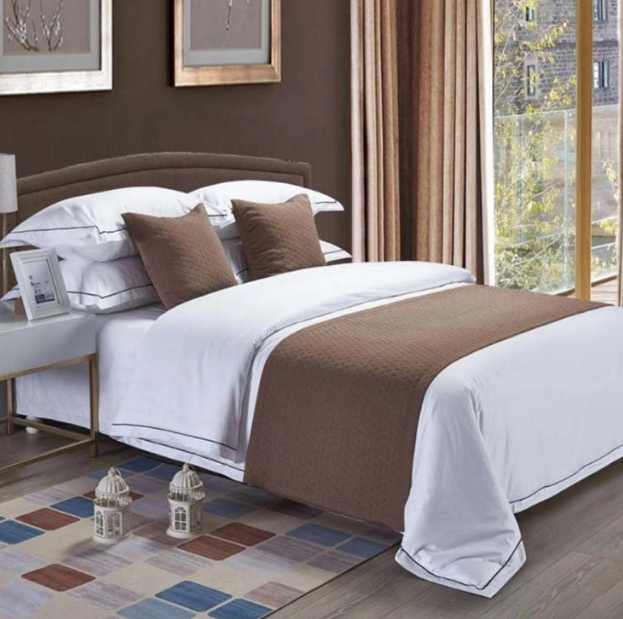
A "top list" is useless without segmentation because different properties have vastly different operational needs. A roadside motel does not need the same linens as a five-star resort. Below are global picks categorized by their primary commercial strength.
Best for: Properties where average daily rate (ADR) justifies premium OpEx.
Frette (Italy): Frette remains the industry benchmark for ultra-luxury. Known for using long-staple cotton and maintaining prestigious brand recognition, their linens are often co-branded in suites to signal exclusivity to guests. They are the go-to for historic properties that market themselves on heritage and opulence.
Sferra: This brand focuses heavily on Italian craftsmanship. Sferra is renowned for high-end percales that offer a cool, crisp sleep experience suitable for discerning clientele who prioritize texture over sheen.
Best for: Full-service hotels requiring long lifecycles and technology-driven efficiency.
Standard Textile: A leader in textile engineering, Standard Textile is known for proprietary technologies like Centium Core. This innovation weaves cotton around a synthetic poly core, offering the soft feel of cotton against the skin with the superior durability of synthetic fibers at the center. This significantly extends the life of the product.
1888 Mills: A major US-based player with global manufacturing capabilities. They offer distinct lines like "Magnificence" that are designed to balance cost with commercial endurance, making them a favorite for business hotels that need reliable, consistent stock.
Best for: Green-certified hotels and eco-resorts.
Venus Group: These are innovators in sustainable manufacturing. Venus Group utilizes recycled water systems and eco-friendly fibers without sacrificing the crisp hotel feel guests expect. Their focus on reducing the carbon footprint of production appeals to modern, eco-aware hotel brands.
1Concier: Formed from the merger of legacy brands like Riegel and T-Y Group, 1Concier emphasizes closed-loop water systems in manufacturing and sustainable sourcing. They provide transparency in their supply chain, which is critical for hotels reporting on ESG goals.
Best for: Airbnb hosts, vacation rentals, and small inns requiring lower MOQs.
Bedsure / Utopia (B2B Divisions): These suppliers offer "hotel style" microfiber and blends with lower minimum order quantities (MOQs). Their flexible shipping and lower entry costs make them ideal for operators who cannot store 500 units of inventory but still need professional-looking linens.
Direct Textile Store: Acting as a distributor for various mills, this supplier offers excellent transparency on specifications. They provide smaller case-pack purchasing options, allowing smaller properties to buy commercial-grade linens without the burden of massive wholesale orders.
The fabric composition dictates the guest experience and the laundry bill. Understanding the trade-offs between materials is essential for selecting the best hotel bedding for your specific climate and guest demographic.
100% Cotton (Long-Staple/Egyptian):
Pros: Superior breathability, cool touch, luxury perception.
Cons: High shrinkage risk, requires ironing/pressing, shorter lifespan.
Verdict: Luxury suites only.
Cotton-Polyester Blends (Poly-Cotton):
Pros: Wrinkle-resistant, faster drying (energy savings), high tensile strength.
Cons: Can pill if low quality.
Verdict: The industry workhorse (specifically 60/40 blends).
Microfiber:
Pros: Extremely cheap, dries instantly, stain-resistant.
Cons: Traps heat, feels "synthetic" to sensitive guests.
Verdict: Budget motels and high-turnover vacation rentals.
To help visualize the difference in performance and feel, refer to the comparison below:
| Feature | Percale Weave | Sateen Weave |
|---|---|---|
| Structure | One-over, one-under (Grid-like) | Three-over, one-under (Loose float) |
| Hand Feel | Crisp, cool, matte finish | Silky, smooth, slight sheen |
| Heat Retention | Low (Very breathable) | Medium (Warmer feel) |
| Durability | High (Resistant to pilling) | Moderate (Prone to snagging) |
| Best Use Case | Warm climates, "Freshly starched" feel | Cold climates, "Drapey" luxury look |
Buying hotel bedding sets is a capital expenditure; managing them is an operating expense. Improper inventory levels lead to premature linen failure because fibers are not given enough time to recover between uses.
Most efficient hotels operate on a 3-Par to 5-Par system per bed. This inventory buffer ensures that operations never stall due to laundry bottlenecks:
1 Par: In the room (currently on the bed).
1 Par: In the laundry cycle (being washed/dried).
1 Par: In the closet (shelf rest).
Note: A 4th or 5th Par is highly recommended for high-season buffers or emergency replacement stock. Running with only 2 Pars ensures that linens are washed immediately after stripping, which accelerates wear and tear.
Cotton fibers need to recover humidity and relax after the stress of high-heat industrial ironing. The "shelf rest" is not just storage; it is a maintenance step. Best practice dictates allowing linens to rest on the shelf for 24 hours before re-use. Studies suggest this simple rotation step can extend linen life by up to 20% by preventing fiber embrittlement and breakage.
Do not just look at the invoice price. You must calculate the Cost Per Use. Use the following logic:
$$ \text{Cost Per Use} = \frac{\text{Purchase Price} + \text{Laundering Cost over Life}}{\text{Number of Useful Cycles}} $$
A slightly more expensive sheet that survives 50 more washes is often cheaper per room night than a budget sheet that requires frequent replacement. This is the core of smart procurement.
When finalizing a contract with a wholesale supplier for hotel bedding, validate their logistics capabilities to avoid operational bottlenecks. Price is important, but availability is critical.
MOQ and Break-Bulk Capabilities: Can the supplier ship single cartons for emergency top-ups, or do they only ship full pallets? This is critical for properties with limited storage space who cannot house six months of inventory at once.
Discontinued Stock Protection: Does the supplier guarantee the availability of your specific SKU for 2-3 years? Mixing different shades of white due to forced product switches is a branding disaster. Ensure your contract includes clauses for stock continuity.
Sampling Protocol: Never buy bulk without a wash test. Order a sample case, run it through your specific laundry machinery 5–10 times, and measure shrinkage and hand-feel changes. What feels good out of the box may pill or shrink significantly after the first industrial wash.
Selecting the right supplier requires looking beyond the "luxury" label to analyze the intersection of guest comfort and operational resilience. Whether you choose the heritage prestige of Frette or the engineered durability of Standard Textile, the goal is consistent quality that matches your brand promise.
By adhering to correct Par levels (3–5), choosing the right weave for your climate, and calculating the total cost per wash cycle, you can secure wholesale hotel bedding that protects your bottom line while delivering the "royal treatment" guests expect. The right linen strategy turns a recurring expense into a competitive advantage.
A: True commercial hotel bedding is engineered for industrial laundering (high heat, strong bleach, heavy extraction). It often uses stronger hems and balanced weaves compared to retail bedding, which focuses on shelf appeal and softness out of the package.
A: White bedding proves cleanliness to the guest (there is nowhere to hide stains) and allows housekeeping to use bleach for sanitization without fading colors. It creates a "halo effect" of hygiene around the bed.
A: For a balance of durability and luxury, 250 to 300 thread count is the industry standard. Thread counts over 600 often indicate multi-ply yarns that may reduce breathability and durability in commercial settings.
A: Depending on occupancy and par rotation, bed sheets typically last 12–18 months, while pillowcases (which are washed more frequently and stained by cosmetics) may need replacement every 6–12 months.
A: Generally, no. While microfiber is durable and cost-effective, it lacks the breathability and "crisp" feel associated with luxury stays. It is better suited for budget or economy accommodations where durability is the primary metric.


